
.png)
PLANT ECOPHYSIOLOGY LAB
ABOUT THE LAB
-
DESCRIPTION
The Plant Ecophysiology group studies plant responses to abiotic factors (e.g., flooding, drought, wind, irradiance and atmospheric CO2) and biotic factors (insects and diseases) with emphasis on subtropical and tropical horticultural crops. Plant responses studied include leaf gas exchange variables, plant water use, xylem sap flow, plant growth and yield. Plant responses to biotic factors are investigated in cooperation with entomologists and plant pathologists.
The limestone soil, high water table, and subtropical climate in south Florida provide an ideal environment for development of numerous plant stresses. We focus on understanding physiological bases for plant responses to these stresses in order to develop methods of avoiding or mitigating the negative impacts of these stresses on plants.
Another focus of the program is the development of best management practices to increase the compatibility of agriculture with the adjacent natural and urban ecosystems.
RESEARCH
Our research focuses on plant ecophysiology with the primary aim of assessing the effects of environmental stresses on whole-plant physiology of subtropical and tropical horticultural crops. We also collaborate with colleagues in other disciplines to determine the interactions of biotic and abiotic stresses on crop physiology.
Leaf gas exchange, chlorophyll fluorescence, and plant water relations are determined as physiological indicators of plant stress and to identify mechanism underlying the causes of these stresses.
-
RESEARCH PROJECTS
Current Doctoral Students' Research Project
Understanding priming and stress memory to improve water use efficiency in peanut (Aline de Carmargo Santos, Ph.D. Student)
Plant priming is
-2-240x250.jpg) a process whereby a slight stress is imposed on plants to improve tolerance to a later more severe stress. This project aims to understand how priming peanut plants for water stress can improve stress tolerance and minimize the effects of water constraints to crop production. We are priming plants by applying a mild water deficit early in the plant development cycle or a seed treatment with elicitors (natural or synthetic compounds) as stress management strategies. Then, primed and non-primed plants’ responses to water stress are being evaluated using a high throughput phenotyping platform that continuously monitors physiological plant traits and environmental conditions. We aim to assess the effectiveness of priming treatments in terms of net CO2 assimilation, whole-plant transpiration, and growth under water stress and recovery. This research will contribute to our understanding of priming and stress acclimation physiology, and we will potentially develop stress management approaches that farmers can adopt to minimize crop losses to water stress.
a process whereby a slight stress is imposed on plants to improve tolerance to a later more severe stress. This project aims to understand how priming peanut plants for water stress can improve stress tolerance and minimize the effects of water constraints to crop production. We are priming plants by applying a mild water deficit early in the plant development cycle or a seed treatment with elicitors (natural or synthetic compounds) as stress management strategies. Then, primed and non-primed plants’ responses to water stress are being evaluated using a high throughput phenotyping platform that continuously monitors physiological plant traits and environmental conditions. We aim to assess the effectiveness of priming treatments in terms of net CO2 assimilation, whole-plant transpiration, and growth under water stress and recovery. This research will contribute to our understanding of priming and stress acclimation physiology, and we will potentially develop stress management approaches that farmers can adopt to minimize crop losses to water stress.Physiological, biochemical, and morphological responses of achachairu (Garcinia humilis) to soil salinity and flooding with fresh or saline water (Federico Sanchez, Ph.D. Student)
Floodi
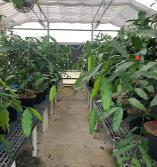 ng, soil salinity, and saltwater intrusion cause abiotic stresses to tropical plants and present a significant source of concern for tropical fruit horticulture and the preservation of the biodiversity of wild tropical fruit trees. The achachairu (Garcinia humilis, family Clusiaceae) is a tropical fruit tree from the tropical regions of Bolivia, where the fruit is harvested from cultivated and wild trees for its delicious taste. Minimal research has been done on the horticulture and ecophysiology of G. humilis, and on its tolerance to soil salinity, and flooding. The objectives of this project are to study the physiological responses (leaf gas exchange, chlorophyll fluorescence, chlorophyll index, ion accumulation), biochemical responses (antioxidant mechanisms, osmolytes, non-structural carbohydrates content, leaf nutrient levels), and morphological responses of G. humilis to flooding with fresh and saline water, and to soil salinity, to determine their tolerance to these combined stresses, and to research the effect of defoliation on post-stress recovery.
Current Collaborative Research Projects
Plant Safety, Horticultural Benefits, and Disease Efficacy of Essential Oils for Use in Organically Grown Fruit Crops: From the Farm to the Consumer
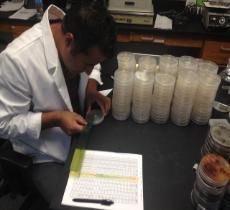
This USDA, OREI funded research and extension project led by Dr. Ali Sarkhosh (University of Florida, Gainesville) is a collaboration among the University of Florida, the University of Georgia, Clemson University, the University of California-Riverside, the University of Hawaii and the U.S. Department of Agriculture. The project will determine the efficacy of organically certified plant essential oils on controlling fungal diseases in avocado, mango, peach and blueberry crops and the best application rates and timing for the most efficient disease control. Essential oil effects on controlling insect pests are also being assessed.
Our lab in collaboration with Dr. Romina Gazis' and Dr. Jonathan Crane's labs is determining the effects of plant derived essential oils on controlling anthracnose disease, caused by the fungus Colletototrichum gloeosporioides, in avocado and mango leaves and fruit. Experiments are being conducted in the lab (in vitro studies), greenhouse (using potted plants) and in organic orchards owned and managed by south Florida growers.
Reducing Avocado Losses to Major Challenges by Improving Resistance Selection and Disease Management Using Next Generation Technologies
This USDA, SCR
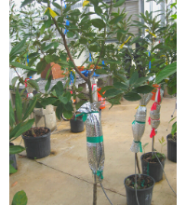 I funded project led by Dr. Patty Manosalva (University of California, Riverside) is a collaboration among the University of California-Riverside, the University of Florida, the University of Hawaii, Texas A&M University, the University of Milan (Italy), and the U.S. Department of Agriculture.
A major constraint to growing avocado trees in many parts of the world, including California, is Phytophthora root rot (PRR) caused by the fungus Phytophthora cinnamomi. Laurel wilt (LW), a vascular disease caused by the fungus Raffealea lauricola, has killed thousands of avocado trees in Florida orchards. LW is not in California but is spreading westward from the east coast of the U.S. and is anticipated to eventually reach California.
The overall goal of this project is to control PRR and LW with PRR- and salinity-tolerant avocado rootstocks developed by researchers at the University of California, Riverside. These rootstocks will be tested in multistate field trials. Other aspects of the project involve testing physiological responses to LW of these rootstocks with different scions, evaluating new fungicides for PRR control, developing in-field DNA- and protein-based diagnostic tools for PRR and LW, and developing remote sensing technology for diagnostics and disease management.
Our lab in cooperation with Dr. Romina Gazis’ lab is testing the susceptibility and physiological responses (leaf gas exchange, plant water use, xylem sap flow) to LW of these new PRR- and salinity-tolerant avocado rootstocks grafted with different scions. Also, in cooperation with Dr. Jonathan Crane’s program, we are field testing the performance of these rootstocks with different scions under south Florida avocado growing conditions.
Integrating Data from Ground Measurements, Unmanned Aerial Vehicles, And Modeling to Quantify Plot Scale Evapotranspiration
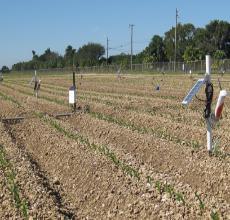
This project funded by the USDA-NIFA and led by Dr. Haimanote Bayabil (University of Florida, TREC, Homestead) focuses on increasing irrigation efficiency of bean and corn crops by developing methodology for artificially intelligent (AI) irrigation systems that estimate evapotranspiration. Data are being integrating from multiple sources from both ground and aerial measurements for use in developing hydrologic and crop models. The goal is to develop a method for measuring plot-level evapotranspiration rates that will allow the implementation of precision irrigation management practices at fine resolutions and fine-tuning of crop growth and hydrologic models. Implementing precision water management practices should result in water savings but also in more efficient nutrient use and increased crop production. Crop water use and plant stress are being quantified at the individual plant and field levels. Our lab is assisting in quantifying stress and plant water use at the plant level.
PEOPLE
Many of our lab members are international, particularly from countries where subtropical and tropical horticultural crops are grown. Graduate students take classes on the main campus in Gainesville and conduct their research at the Tropical Research and Education Center (TREC). Most of them finish their coursework in 2-3 semesters and then move to TREC to concentrate on their research and stay in graduate student housing.
-
CURRENT LAB MEMBERS
Current Lab Members
-160x190.JPG)
Bruce Schaffer - Professor
- Postdoc Biology, University of Heidelberg, Germany, 1985
- Ph.D. Horticulture (Plant Physiology), Virginia Tech University, 1985
- M.S. Forest Biology, Colorado State University, 1981
- B.S. Entomology (Zoology, 2nd Major), Colorado State University, 1978

Ana I. Vargas - Biological Scientist III and Lab Manager
- M.S. Engineering Management, Florida International University, 2012
- B.S. Biology, Florida International University, 2011
- B.S. Agronomy, University of Pinar del Rio, Cuba, 1998
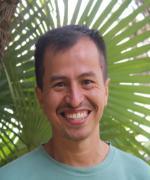
Edwin Antonio Gutiérrez Rodriguez – Postdoc
-
Ph.D. Agronomy, Sao Paulo State University, Brazil, 2016
-
Internship- UF-TREC, 2016
-
M.S. Horticultural Sciences, Rio Grande do Sol Federal University, Brazil, 2012
- B.S. Agronomy, Unillanos University, Colombia, 2008
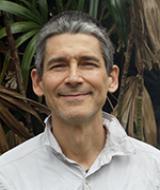
Federico Sanchez - Ph.D. Student
-
- M.S. Horticultural Sciences, University of Florida, 2022
- M.B.A. Harvard Business School, 1995
- B.S. Business Administration, UCAB, Venezuela, 1992
ALINE DE CAMARGO SANTOS – Ph.D. Student
- M.S. Agronomy, University of Florida, 2019
- B.S. Agricultural Sciences, University of São Paulo, Brazil, 2016
 Kevin Castro - Agricultural Assistant
PUBLICATIONS
-
Publication links
Google Scholar: Bruce Schaffer - Google Scholar
ResearchGate: https://www.researchgate.net/profile/Bruce_Schaffer