
Tropical Entomology - Avocado Red Mite
Oligonychus yothersi (Acari: Tetranychidae)
-
Description
In Florida and Chile, the avocado red mite Oligonychus yothersi (McGregor) is a common pest of avocados (Vargas and Rodriguez, 2008).
-
Damage
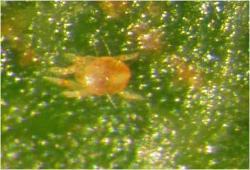
Avocado red mitePart of plant damaged: Leaves
Feeding is first confined to the upper surface of the leaves, along the midrib, then along secondary leaf veins. The areas along the veins become reddish-brown. During heavy infestations leaves can be covered with mite's cast skins. Damage to the leaf area is regularly observed from October through February, causing up to 30% reduction of photosynthetic activity of the leaves. Leaves affected by this mite regularly drop earlier (45-60 days after infestation) than those leaves that have not been infested. This mite is an occasional pest in some orchards and is seldom observed in others.
-
Life Cycle
The duration of the life stages varies from 14 to 15 days. Females are capable of laying 40 to 50 eggs during their life span (Peña and Johnson, 1999). In Chile, life span is completed in 27 days, with higher density peaks between January and May (Vargas and Rodriguez, 2008).
-
Management
Monitoring and Action Levels
Periodic inspections are recommended during December, January and February. Control measures may be started when the population reaches 6 or more mites per leaf. (Peña and Johnson, 1999).
Biological Control
In Chile, natural enemies of avocado red mite include Stethorus histrio Chazeau, the staphylinid beetle Oligota pygmea Solier, and the phytoseiid Cydnodromus picanus Ragusa (Vargas and Rodriguez, 2008).
Chemical Control
In Florida, few miticides are registered for use on avocados when fruit is present. Sulfur or oil emulsion sprays are recommended (Peña and Johnson, 1999). In Chile, mineral oil is considered effective against eggs and motile stages (Vargas and Rodriguez, 2008). Severe outbreaks of this mite have been observed after the use of neonicotinoid insecticides (Imidacloprid and Thiametoxam), as foliar sprays and through the irrigation system.
-
References
Peña, J., and Johnson, F. (1999). Insect management of avocados. Insect Management Guide, Department of Entomology and Nematology, Florida Cooperative Extension Service, University of Florida; http://edis.ifas.ufl.edu/Body_IG068
Vargas, R., and Rodriguez, S. (2008) Avocado red mite, Oligonychus yothersi (McGregor) In :Manejo de plagas en paltos y cítricos, Ripa, R., and P. Larral (eds) Instituto de Investigaciones Agropecuarias, Ministerio de Agricultura, La Cruz, Chile, Colleccion de Libros INIA 23, 239-246.